
Concrete Mixer Machine Complete Guide: Types, Prices, Features & Buying Tips for India
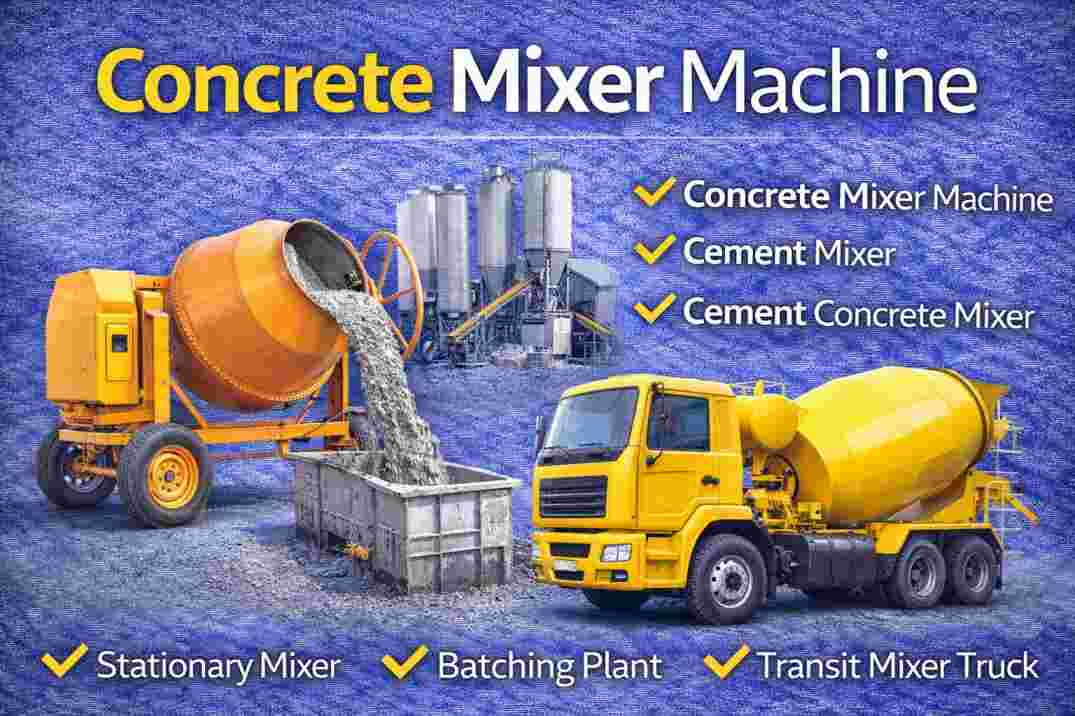
In construction, few pieces of equipment are as fundamental and universally essential as the concrete mixer machine. From small residential projects to massive infrastructure developments, these workhorses of the construction industry ensure that the most critical building material—concrete—is mixed thoroughly, consistently, and efficiently. A quality concrete mixer transforms raw ingredients of cement, sand, aggregates, and water into the uniform, homogeneous mixture that forms the foundation of durable structures. Whether you're a contractor evaluating equipment investments, a builder planning a project, or a homeowner undertaking construction work, understanding concrete mixer machines—their types, capacities, features, and selection criteria—is essential for making informed decisions that balance performance, productivity, and budget. This comprehensive guide explores everything you need to know about concrete mixer machines available in the Indian market, helping you choose the right equipment for your specific requirements.
Understanding Concrete Mixer Machines
A concrete mixer machine, also commonly known as a cement mixer, is mechanical equipment designed to combine cement, aggregates (sand and gravel), and water into a homogeneous concrete mixture. The fundamental principle involves rotating a drum or container that tumbles the ingredients, ensuring thorough mixing and preventing segregation of components.
The importance of proper concrete mixing cannot be overstated. Inadequate mixing results in weak spots, inconsistent strength, poor workability, and potential structural failures. Manual mixing, while still used for very small quantities, is labor-intensive, inconsistent, time-consuming, and physically demanding. Mechanical concrete mixers solve these problems by providing consistent quality regardless of batch size, significantly faster production compared to manual methods, reduced labor requirements and associated costs, better concrete strength through uniform mixing, and the ability to handle larger volumes efficiently.
According to IS 1791:1968, the Bureau of Indian Standard specification for concrete mixers, these machines must ensure uniform mixing for reliable operation . Quality concrete mixers adhere to these standards, providing the consistency essential for structural integrity.
Types of Concrete Mixer Machines
Concrete mixers come in various configurations designed for different applications, capacities, and site conditions. Understanding these types helps in selecting equipment matched to specific project needs.
Tilting Drum Concrete Mixer
The tilting drum mixer represents the most common type found on Indian construction sites. These machines feature a rotating drum mounted on a tilting frame, mixing ingredients through tumbling action as the drum rotates. Once mixing is complete, the entire drum tilts to discharge the concrete.
Key characteristics include simple, robust construction with minimal maintenance requirements, easy discharge by tilting the drum, suitable for small to medium batches, and relatively economical compared to other types. Specially built mixing blades mounted on the inside surface of the tiltable drum ensure thorough mixing . Tilting drum mixers are widely used for residential construction, small commercial projects, repair and maintenance work, and situations requiring portable, easy-to-operate equipment.
Reversible Drum Concrete Mixer
Reversible drum mixers operate on a different principle. The drum rotates in one direction to mix the concrete and reverses direction to discharge the mixture . This design eliminates the need for drum tilting mechanisms, making the structure simpler in some aspects.
Advantages include no tilting mechanism required, potentially faster discharge, suitable for continuous production, and good for transit mixing applications. Reversible drum mixers have become most reliable for quality output and maintenance-free operation . These mixers excel in ready-mix concrete applications, projects requiring continuous concrete supply, mobile batching plants, and larger construction sites with high concrete demand.
Hydraulic Concrete Mixer
Hydraulic concrete mixers incorporate hydraulic systems for various functions including drum tilting, hopper operation, and loading mechanisms. These advanced machines offer enhanced convenience and efficiency, particularly for larger operations.
Features typically include hydraulic tilting for easy discharge, hydraulic hopper systems for material loading, load cell-based weighing systems for accurate batching in some models, and reduced manual effort in operation. Concrete mixer machines with hydraulic hoppers fitted with load cells are popular choices among builders and contractors, especially for monitoring material inputs in government projects . The precision and convenience justify the higher investment for medium to large projects, government contracts requiring material documentation, operations prioritizing efficiency and accuracy, and contractors handling multiple simultaneous projects.
Pan Mixer (Planetary Mixer)
Pan mixers use a different mixing mechanism where materials are placed in a stationary pan while mixing blades rotate within it. This design provides more intensive mixing action compared to drum mixers, making pan mixers ideal for producing high-strength concrete, precast concrete products, colored concrete requiring uniform pigment distribution, and specialty concrete mixes with specific requirements.
Pan mixers offer superior mixing quality, faster mixing cycles, better for dry or stiff mixes, and excellent uniformity. However, they're typically more expensive and have smaller batch capacities compared to drum mixers of similar physical size.
Mobile and Self-Loading Concrete Mixers
Mobile concrete mixers combine mixing capabilities with transportation, mounted on wheeled chassis or truck beds. Self-loading variants include built-in loading mechanisms that scoop materials directly into the drum. These specialized machines suit infrastructure projects spread over large areas, sites with difficult access, projects requiring concrete at multiple locations, and operations where centralized batching isn't practical.
Concrete Mixer Capacity Classifications
In India, concrete mixers are commonly classified by their batch capacity, typically measured in "bags" of cement. Understanding these classifications helps select appropriate equipment for project scale.
Half Bag Concrete Mixer (5/3.5 CFT)
Half bag mixers accommodate approximately half a standard 50kg cement bag along with corresponding proportions of sand and aggregates. These compact machines are ideal for very small projects and repairs, residential renovation work, masonry mortar mixing, and DIY construction activities. Their portability and economy make them popular for small contractors and individual builders.
One Bag Concrete Mixer (10/7 CFT)
The 1 bag concrete mixer machine of 10/7 capacity is one of the flagship products in the Indian construction industry, with a reputation for strength, rigidity, and extended life . This represents the standard workhorse for most small to medium construction projects.
One bag mixers handle one 50kg cement bag with appropriate aggregate proportions per batch, suitable for residential house construction (up to 3-4 floors), small commercial buildings, and foundation work. 1 bag concrete mixer machine prices in India range approximately from ₹70,000 to ₹1,50,000 or more depending on features, brand, and power source . The balance between capacity, portability, and cost makes one bag mixers the most popular category in India.
Larger Capacity Mixers
For bigger projects, mixers with capacities of 1.5 bags, 2 bags, or more are available. These industrial-grade machines suit large commercial construction, high-rise building projects, infrastructure development, and precast concrete manufacturing facilities. While offering higher productivity, they require more powerful drives, are less portable, and command premium prices.
Power Source Options
Concrete mixer machines are available with different power sources, each offering specific advantages depending on site conditions and requirements.
Electric Motor Driven Mixers
Electric motor variants, typically 5 HP three-phase motors for one bag capacity mixers, are available to suit unique site requirements . Electric mixers offer lower operating costs compared to diesel, quieter operation, suitable for indoor or noise-sensitive areas, minimal maintenance, and instant start capability.
However, they require reliable electrical supply, are unsuitable for remote sites without power, and face limitations during power cuts. Electric mixers excel in urban construction sites, projects with stable power supply, indoor or enclosed spaces, and operations prioritizing lower running costs.
Diesel Engine Driven Mixers
Diesel variants with 6 HP Kirloskar TAF 1 engines or similar are popular alternatives . Diesel mixers provide site independence without electrical requirements, suitability for remote locations, operation during power outages, and higher torque for heavy-duty applications.
Drawbacks include higher fuel costs, more noise and emissions, regular engine maintenance requirements, and higher initial purchase price. Diesel mixers suit rural or remote construction sites, areas with unreliable power supply, infrastructure projects, and temporary site offices or camps.
Petrol Engine and Manual Options
Small petrol engine mixers offer portability and flexibility for very light-duty applications. Manual concrete mixers, operated by hand cranking, remain available for the smallest jobs or emergency situations, though they're increasingly rare given the availability of affordable motorized alternatives.
Key Features and Components
Understanding the critical components and features of concrete mixer machines helps evaluate quality and suitability.
Mixing Drum
The drum is the heart of the mixer, typically fabricated from mild steel sheets of 2.5mm to 3mm thickness for durability. Quality drums feature proper mixing blade configuration mounted on internal surfaces, adequate capacity with appropriate length-to-diameter ratios, smooth internal surfaces preventing material adhesion, and reinforced construction at stress points.
Chassis and Frame
The supporting structure must withstand operational stresses and machine weight. Heavy-duty chassis use appropriate gauge angles and channels, providing stability during operation, proper mounting for drum and drive mechanisms, and adequate ground clearance for uneven sites.
Drive Mechanism
Power transmission from motor to drum uses various methods. Chain and sprocket drives are common, offering reliable operation, easy maintenance, and good power transmission. Some machines use gear drives for higher efficiency and quieter operation, though at higher cost. The drive should provide smooth operation, handle rated loads without slipping, and include safety guards.
Wheels and Mobility
Most portable mixers include wheels for site mobility. Quality features include pneumatic tires for rough terrain navigation, adequate wheel size and bearing capacity, towing attachments for larger mixers, and parking brakes for operational safety.
Hopper and Loading System
Material loading systems range from simple manual shoveling to sophisticated hydraulic hoppers. Advanced features include hopper capacity matching drum size, mechanical or hydraulic lifting mechanisms, load cell weighing systems for accurate batching, and multiple bin configurations for different aggregates.
Concrete Mixer Machine Price in India
Understanding concrete mixer machine prices helps budget appropriately for equipment investments. Prices vary significantly based on capacity, features, brand, and power source.
Budget Range Machines
Entry-level half bag to one bag mixers from lesser-known manufacturers or basic configurations typically range from ₹40,000 to ₹80,000. These suit occasional use, very small projects, or extremely tight budgets, though quality and longevity may be limited.
Standard Quality Machines
Standard one bag concrete mixer machines from reputable manufacturers range approximately from ₹80,000 to ₹1,50,000 . This category represents the sweet spot for most contractors and builders, offering reliable performance, established brand support, standard features meeting most needs, and reasonable warranties.
Premium and Specialized Machines
High-end one bag mixers with hydraulic systems, digital weighing, or other advanced features can exceed ₹2,00,000. Larger capacity mixers, pan mixers, and mobile batching plants range from ₹2,50,000 to ₹10,00,000 or more depending on sophistication and capacity.
Factors Affecting Price
Several variables influence concrete mixer pricing including brand reputation and market position, power source (diesel typically costs more than electric), capacity and batch size, additional features like hydraulic systems or load cells, build quality and materials used, warranty coverage and after-sales support, and regional variations based on transportation and dealer networks.
Top Concrete Mixer Brands in India
Several established manufacturers dominate the Indian concrete mixer market, each offering different strengths.
Jaypee India Limited
Jaypee India Limited is recognized as the largest construction equipment manufacturing unit in India, with over 40 years of experience . Their mixers are known for robust construction, IS standard compliance, extensive dealer networks, and comprehensive after-sales support. Jaypee mixers are widely trusted across residential, commercial, and infrastructure projects.
Other Established Brands
Minerva Industries from Coimbatore offers a comprehensive range of mixers with heavy-duty construction and competitive pricing. VPG Buildwell, established since 1972, provides reliable equipment with good market presence in South India. Ajax, Schwing Stetter, and international brands offer premium options for demanding applications.
Regional manufacturers across India provide economical alternatives, often offering good value for budget-conscious buyers, though brand support and consistency may vary.
Selecting the Right Concrete Mixer Machine
Choosing appropriate equipment requires evaluating multiple factors specific to your requirements.
Project Scale and Duration
For small, short-duration projects, a half bag or economical one bag mixer suffices. Medium-sized projects justify investing in quality one bag mixers with good features. Large or long-term projects benefit from higher-capacity or hydraulic systems that improve efficiency despite higher costs.
Concrete Volume Requirements
Calculate daily or peak concrete requirements to determine adequate capacity. A one bag mixer typically produces 2-3 cubic meters per hour with good workflow. Ensure capacity matches demand without excessive oversizing that reduces efficiency.
Site Conditions
Available power supply determines electric versus diesel choice. Site terrain affects wheel size and mobility requirements. Space constraints may limit mixer size. Distance from material storage influences hopper and loading considerations.
Budget Considerations
Balance initial purchase cost against long-term value, considering operating costs over expected usage period, maintenance requirements and parts availability, resale value if planning to sell after project completion, and rental alternatives for short-term needs.
Quality Indicators
When evaluating machines, examine drum thickness (minimum 2.5mm for durability), frame and chassis robustness, quality of motor or engine (prefer known brands like Kirloskar, Crompton), drive system design and materials, finish quality and paint, IS standard compliance certification, manufacturer reputation and market presence, and warranty terms and conditions.
Operation and Maintenance Best Practices
Proper operation and maintenance maximize mixer lifespan and performance.
Operating Guidelines
Always follow manufacturer specifications for maximum batch size, avoiding overloading. Load materials in correct sequence—typically water first, then cement and sand, finally coarse aggregates. Mix for adequate duration (2-3 minutes minimum) to ensure uniformity. Clean the drum thoroughly after each use to prevent concrete buildup. Never operate without proper safety guards in place.
Maintenance Schedule
Daily maintenance includes cleaning mixer drum and exterior surfaces, checking oil levels in engine (diesel models), inspecting drive belts and chains for tension, and verifying all guards are secure. Weekly tasks involve lubricating bearings and moving parts, checking tire pressure and wheel bearings, tightening any loose bolts or fasteners, and inspecting electrical connections (electric models).
Monthly maintenance encompasses changing engine oil (diesel models), inspecting and adjusting drive chain tension, checking drum rotation smoothness and bearing condition, examining frame for cracks or damage, and verifying safety features function properly. Annual service should involve comprehensive inspection by qualified technicians, replacement of worn components, repainting if needed for corrosion protection, and recalibration of weighing systems if equipped.
Common Problems and Solutions
If the drum doesn't rotate, check power supply or fuel, verify drive belt or chain isn't broken, and ensure clutch engages properly (if equipped). For poor mixing quality, check blade condition and replace if worn, verify proper material proportions and sequencing, and ensure adequate mixing time. Excessive vibration indicates checking for unbalanced drum or material buildup, verifying wheel bearings aren't worn, and ensuring machine is on level ground. Difficulty discharging concrete suggests checking tilting mechanism lubrication and function, cleaning drum interior of buildup, and ensuring proper material consistency.
Safety Considerations
Safe operation protects workers and equipment. Essential safety practices include never inserting hands or tools into rotating drum, always wearing appropriate PPE including gloves, safety shoes, and eye protection, ensuring proper grounding of electric mixers, keeping work area clean and free of trip hazards, never exceeding rated capacity, shutting down before any maintenance or cleaning, training all operators on proper procedures, maintaining safety guards in place at all times, using proper lifting techniques when loading materials, and having emergency stop mechanisms readily accessible.
Rental vs. Purchase Decision
Determining whether to rent or buy depends on specific circumstances. Purchase makes sense for regular, ongoing construction business, long-duration projects (typically over 6 months), desire to build equipment asset base, and situations where rental availability is limited. Rental suits short-term or one-time projects, testing equipment before purchase commitment, avoiding maintenance responsibilities, and eliminating depreciation concerns.
Calculate break-even points comparing total rental costs versus purchase price plus operating costs over your expected usage period.
Future Trends in Concrete Mixing Technology
The concrete mixer industry continues evolving with technological advances. Emerging trends include automation and smart features with sensors monitoring mix quality, automated batching systems reducing human error, and IoT connectivity for remote monitoring and diagnostics. Electric and alternative power solutions reduce environmental impact and operating costs. Improved mixing mechanisms achieve better quality in shorter times. Compact designs maintain capacity while improving portability. Enhanced safety features protect operators more effectively.
While these innovations may increase initial costs, they improve productivity, quality, and safety, potentially justifying investments for forward-thinking contractors.
OMJI Construction's Approach to Concrete Mixing
At OMJI Construction, we recognize that quality concrete begins with proper mixing. Our equipment fleet includes modern concrete mixer machines selected for reliability, efficiency, and appropriate capacity for diverse project scales. We maintain rigorous maintenance schedules ensuring equipment operates at peak performance, regularly train operators on best practices and safety protocols, and combine mechanized mixing with quality control testing to ensure every batch meets specifications.
For clients planning their own projects, we provide guidance on equipment selection, rental options for short-term needs, and operator training to ensure safe, effective operation. Our experience across residential, commercial, and infrastructure projects gives us unique insight into matching equipment capabilities to project requirements.
Conclusion
The concrete mixer machine represents a fundamental investment for anyone involved in construction, from individual homebuilders to large contracting firms. Understanding the various types available—from simple tilting drum mixers to sophisticated hydraulic systems—helps match equipment to specific needs. Capacity considerations, power source selection, brand reputation, and pricing all factor into optimal choices. While prices range from around ₹40,000 for basic models to several lakhs for advanced systems, the investment in quality equipment pays dividends through consistent concrete quality, improved productivity, and reduced labor costs. Whether purchasing your first mixer or upgrading existing equipment, prioritizing reliability, appropriate capacity, and good after-sales support ensures your concrete mixer machine serves your projects well for years to come. At OMJI Construction, we're committed to helping clients navigate these decisions, whether through equipment guidance, rental options, or complete construction services backed by our expertise in producing quality concrete through proper mixing practices. The foundation of every strong structure begins with properly mixed concrete—and that starts with choosing the right concrete mixer machine for your needs.


