
IS 456:2000 Complete Guide - Indian Standard for Reinforced Cement Concrete & Concrete Grades
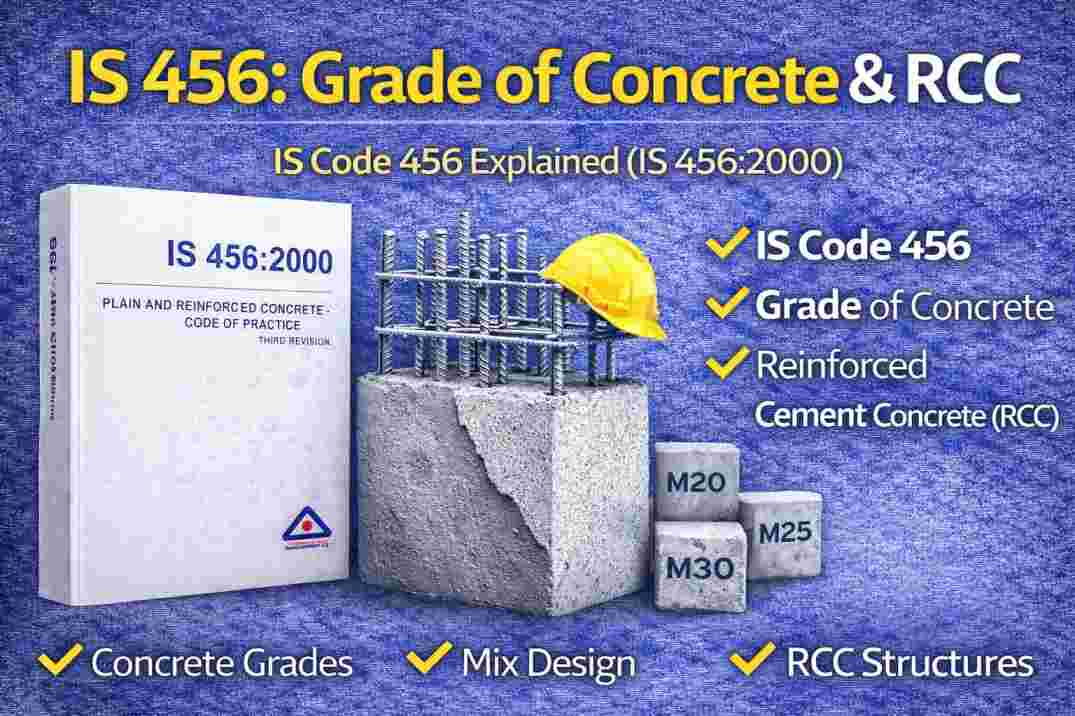
In the world of construction, adherence to established standards is not just about regulatory compliance—it's about ensuring safety, durability, and structural integrity for decades to come. IS 456:2000, officially titled "Plain and Reinforced Concrete - Code of Practice," represents the cornerstone document governing concrete construction across India. Published by the Bureau of Indian Standards (BIS), this comprehensive code provides detailed guidelines for everything from material selection and mix design to structural analysis and construction practices. Whether you're a civil engineer designing a high-rise building, a contractor executing foundation work, or a property owner seeking to understand construction specifications, familiarity with IS Code 456 is essential. This guide explores the key provisions, grade of concrete classifications, design principles, and practical applications of this vital standard.
Understanding IS 456: History and Evolution
IS 456 was first published in 1953 under the title "Code of Practice for Plain and Reinforced Concrete for General Building Construction." The code has undergone multiple revisions to keep pace with advancements in concrete technology, construction practices, and international standards. The first revision came in 1957, followed by significant updates in 1964 when the scope expanded beyond general building construction to include all concrete structures.
The third revision in 1978 introduced the Limit State Method of design, representing a paradigm shift from the older Working Stress Method. The current version, IS 456 2000, published in July 2000 and reaffirmed in 2005, 2016, and most recently in 2021, incorporates modern concrete technology developments and aligns with international best practices while remaining suited to Indian construction conditions.
This fourth revision emphasizes durability as a primary design consideration, introduces simplified sampling and acceptance criteria aligned with British Standards BS 5328, includes all grades of Ordinary Portland Cement (33, 43, and 53 grade), and provides comprehensive guidelines for various exposure conditions affecting concrete structures. The code assumes that design work is entrusted to qualified engineers and execution is carried out under qualified, experienced supervision.
Scope and Application of IS Code 456
The IS code 456 provides comprehensive guidance for the design and construction of reinforced cement concrete structures including buildings of all types, bridges and highway structures, water tanks and retaining structures, foundations and footings, industrial structures and chimneys, and special structures like silos and bunkers.
The code covers materials used in concrete production including various types of cement, aggregates (fine and coarse), water quality requirements, admixtures and additives, and reinforcement steel. It provides detailed specifications for concrete properties such as workability, strength development, durability under different exposure conditions, and mix proportioning for various grades.
For structural design, IS 456 addresses the Limit State Method principles, design of beams, slabs, columns, and walls, shear and torsion considerations, development length and anchorage requirements, and deflection and crack width control. Construction practices covered include mixing, transporting and placing concrete, compaction and finishing, curing requirements, formwork and scaffolding, and quality control and testing procedures.
Grade of Concrete: Understanding the Classification System
One of the most fundamental aspects of IS 456 is its classification system for concrete grades. The grade of concrete is designated by the letter 'M' followed by a number representing the characteristic compressive strength in N/mm² (megapascals) that the concrete achieves after 28 days of curing when tested using standard 150mm cubes.
The 'M' stands for "Mix" and indicates the mix proportion of materials. For example, M20 concrete has a characteristic compressive strength of 20 N/mm² after 28 days. This grading system allows engineers, contractors, and suppliers to communicate specifications clearly and ensures consistency across projects.
Concrete Grade Categories
IS 456 classifies concrete into three broad categories based on strength:
Ordinary Concrete (M10, M15, M20): These lower-grade concretes are suitable for non-structural or lightly loaded applications. M10 and M15 are primarily used for lean concrete work, leveling courses, bedding for footings, and temporary structures. M20 represents the minimum grade recommended for reinforced cement concrete (RCC) structural work under mild exposure conditions. M20 is widely used in residential construction for slabs, beams, columns in low-rise buildings, and domestic foundations where structural loads are moderate.
Standard Concrete (M25, M30, M35, M40, M45, M50, M55): These grades form the workhorses of modern construction. M25 concrete offers enhanced strength and durability compared to M20, making it suitable for RCC work under moderate exposure conditions including columns and beams in multi-story buildings, bridge components, and industrial structures. M30 grade provides excellent weather resistance and load-bearing capacity, ideal for high-rise building foundations, highway bridges, water retaining structures, and pre-stressed concrete applications. M35 to M55 grades are progressively stronger, used where higher structural demands exist or aggressive environmental conditions prevail.
High-Strength Concrete (M60, M65, M70 and above): These specialized grades are used for demanding applications including high-rise buildings exceeding certain heights, long-span bridges, marine structures, structures subject to severe chemical exposure, and pre-stressed concrete members. For grades exceeding M55, IS 456 requires that design parameters be established through testing and justification rather than relying solely on code provisions, as the behavior of high-strength concrete can differ significantly from standard grades.
Common Concrete Grades: Detailed Analysis
M20 Concrete
M20 grade concrete represents the minimum acceptable standard for structural RCC work under mild exposure conditions. With a characteristic compressive strength of 20 MPa (approximately 2900 psi), M20 provides adequate performance for residential and light commercial applications.
The nominal mix ratio for M20 is typically 1:1.5:3 (cement:sand:coarse aggregate by volume), though design mix is preferred for critical applications. M20 concrete finds application in residential floor slabs and roof slabs for low-rise buildings, beams and columns in houses, lintels and chajjas, foundations for residential buildings, and water retaining structures with proper waterproofing. While economical and suitable for many applications, M20 should only be used under mild exposure conditions and is not recommended for structures exposed to aggressive environments or heavy loads.
M25 Concrete
M25 grade concrete with 25 MPa compressive strength represents a significant step up in performance from M20. The typical mix ratio is 1:1:2 (cement:sand:coarse aggregate), containing higher cement content that contributes to improved strength and durability.
M25 is widely used for RCC structural elements under moderate exposure including columns and beams in multi-story residential and commercial buildings, footings and foundations for medium-rise structures, bridge piers and abutments, water tanks and underground structures, and pre-cast concrete elements. The enhanced durability of M25 makes it better suited than M20 for structures exposed to moderate environmental challenges such as industrial areas with some pollution, coastal regions at a reasonable distance from the sea, and areas with moderate temperature variations.
M30 Concrete
M30 grade concrete achieving 30 MPa (approximately 4350 psi) compressive strength represents high-standard concrete suitable for demanding applications. Unlike lower grades, M30 is typically produced using design mix rather than nominal mix proportions, with exact ratios determined through laboratory testing of actual materials.
M30 concrete excels in applications requiring superior load-bearing capacity and durability including columns and beams in high-rise buildings, highway bridges and flyovers, industrial floors subject to heavy loads, marine structures with moderate exposure, prestressed concrete members, and infrastructure projects requiring long service life. The higher cement content and carefully controlled mix design result in denser, less permeable concrete that resists weathering, chemical attack, and carbonation more effectively than lower grades. This makes M30 particularly valuable for structures where long-term durability justifies the additional cost.
Design Methods in IS 456
The IS 456 2000 code employs the Limit State Method (LSM) as the primary design philosophy, replacing the older Working Stress Method (WSM) used in earlier versions. This modern approach provides more rational and economical designs while ensuring adequate safety.
Limit State Method Principles
The Limit State Method recognizes that structures must satisfy two fundamental criteria. The Limit State of Collapse addresses ultimate strength and stability, ensuring structures can carry design loads with appropriate safety factors without failure. Critical failure modes considered include flexural failure in beams and slabs, compression failure in columns, shear and torsional failure, and bond and anchorage failure.
The Limit State of Serviceability ensures structures remain functional and aesthetically acceptable during normal use. Key considerations include deflection limits to prevent excessive deformation, crack width control to prevent corrosion and maintain appearance, vibration control for occupant comfort, and durability under environmental exposure.
The LSM approach uses partial safety factors applied to both loads and materials, recognizing uncertainties in load estimation, material strength variations, construction quality, and design assumptions. Load factors typically range from 1.2 for dead loads to 1.5 for live loads, while material factors account for potential variations in concrete and steel strength.
Design Parameters
IS 456 provides comprehensive design parameters for various grades of concrete and reinforcement steel. For concrete, the characteristic compressive strength (fck) is the primary parameter, determined through standard cube testing at 28 days. The code also specifies modulus of elasticity values varying with concrete grade, tensile strength parameters for different calculation purposes, and stress-strain relationships for analysis.
For reinforcement steel, IS 456 covers mild steel (Fe 250) with 250 MPa yield strength, though rarely used now, High Yield Strength Deformed bars (HYSD) including Fe 415 (415 MPa) and Fe 500 (500 MPa), which are most common today, and specialized reinforcement for specific applications. The code provides detailed guidance on minimum and maximum reinforcement percentages, spacing requirements, concrete cover depths for durability and fire protection, and development length requirements for proper stress transfer.
Durability Requirements in IS 456
One of the most significant enhancements in IS 456:2000 compared to earlier versions is the comprehensive treatment of durability. The code recognizes that structural adequacy alone is insufficient—structures must maintain their integrity throughout their intended service life despite environmental challenges.
Exposure Conditions Classification
IS 456 classifies exposure conditions into five categories, each demanding specific concrete grades and protective measures. Mild exposure includes protected members inside buildings with low humidity, requiring minimum M20 grade concrete. Moderate exposure covers members sheltered from severe rain or freezing, members in non-aggressive soil or water, and members in open atmosphere with no severe conditions, requiring minimum M25 grade.
Severe exposure involves members exposed to coastal environments beyond 1km from seawater, members in direct contact with aggressive subsoil or groundwater, and members in industrial areas with aggressive atmosphere, requiring minimum M30 grade. Very severe exposure covers members in coastal areas within 1km of seawater, members in highly aggressive industrial atmospheres, and members in severe chemical environments, requiring minimum M35 grade. Extreme exposure encompasses members in seawater, members in heavily chloride-contaminated areas, and members subject to abrasion from flowing water with debris, requiring minimum M40 grade with special protective measures.
Ensuring Durability
To achieve required durability, IS 456 mandates appropriate concrete grade selection based on exposure, minimum cement content varying from 220 kg/m³ for mild exposure to 360 kg/m³ for extreme exposure, maximum water-cement ratio ranging from 0.55 for mild exposure to 0.40 for very severe exposure, adequate concrete cover depth over reinforcement, proper compaction to minimize voids and permeability, and thorough curing for minimum specified periods.
The code also emphasizes that achieving durability requires attention throughout the construction process, from material selection and mix design to placement, finishing, and curing. Quality control measures must verify that specified requirements are met consistently.
Mix Design and Proportioning
IS 456 provides guidance on concrete mix design through two approaches. Nominal mix proportions are specified for lower grades (M10, M15, M20) where precise control may not be critical. These standardized ratios like 1:3:6 for M10, 1:2:4 for M15, and 1:1.5:3 for M20 are volume-based and suitable for small projects or non-critical applications.
Design mix proportions are required for M25 and higher grades, involving laboratory testing of actual materials to determine optimal proportions achieving target strength economically. Design mix considers aggregate characteristics, cement type and strength, required workability, environmental conditions, and durability requirements. This approach ensures optimal performance while potentially reducing cement content compared to nominal mixes.
The mix design process typically follows IS 10262 guidelines, complementing IS 456's performance requirements. Proper mix design balances strength requirements, durability needs, workability for placement and compaction, economy of materials, and consistency of quality.
Workability and Fresh Concrete Properties
IS 456 addresses workability as a critical property affecting construction quality. Workability refers to the ease with which concrete can be mixed, transported, placed, compacted, and finished without segregation or bleeding. The code provides workability requirements based on application, measured primarily through slump tests.
Recommended slump values range from 25-75mm for beams and slabs reinforced with bars at normal spacing, 50-100mm for heavily reinforced sections or confined areas, 75-100mm for tremie concrete or mass concrete, and potentially higher values when using superplasticizers with proper testing.
Achieving proper workability without compromising strength requires balanced mix design, appropriate water-cement ratio, suitable aggregate grading, and use of admixtures when necessary. Modern chemical admixtures including superplasticizers can significantly enhance workability without increasing water content, allowing production of high-strength, high-performance concrete.
Quality Control and Testing
IS Code 456 emphasizes quality assurance throughout the construction process. For materials, testing requirements include cement testing per IS 4031, aggregate testing per IS 2386, water quality assessment, and admixture compliance verification.
Fresh concrete testing involves slump testing for workability verification, temperature measurement to ensure proper curing conditions, air content testing when using air entraining admixtures, and density checks to detect segregation or inadequate compaction.
Hardened concrete testing focuses primarily on compressive strength using standard 150mm cubes tested at 7 days for early strength indication and 28 days for characteristic strength verification. IS 456:2000 simplified acceptance criteria align with international standards. Concrete is deemed acceptable when the mean strength of samples exceeds the characteristic strength by specified margins and individual test results fall within acceptable limits relative to the characteristic strength.
For structures requiring verification of in-situ concrete strength, IS 456 permits non-destructive testing methods including rebound hammer tests, ultrasonic pulse velocity measurements, and core extraction and testing, though these supplement rather than replace standard cube testing.
Construction Practices Per IS 456
The code provides detailed guidance on concrete construction practices ensuring quality execution. Batching requirements mandate accurate measurement of materials either by weight (preferred for precision) or volume, with mechanical batching recommended for consistency. Mixing can be done using mechanical mixers operated for specified minimum durations to ensure uniform material distribution, or ready-mix concrete from certified suppliers meeting IS 4926 specifications.
Transportation should minimize segregation and workability loss, completed within specified time limits before initial setting begins. Placement requires depositing concrete as close as possible to final position, avoiding segregation during placement, placing in layers of appropriate thickness for proper compaction, and avoiding cold joints through continuous placement or proper joint preparation.
Compaction using mechanical vibrators removes entrapped air and ensures dense, strong concrete, with care taken to avoid over-vibration causing segregation or under-vibration leaving voids. Curing, perhaps the most critical post-placement operation, maintains adequate moisture and temperature for proper cement hydration. IS 456 specifies minimum curing periods of 7 days for ordinary Portland cement concrete and 10 days for mineral admixture concrete or hot weather concreting, though longer periods benefit strength development and durability.
Special Concretes and Advanced Provisions
IS 456 includes provisions for special concrete types and applications. Lightweight concrete using lightweight aggregates for reduced structural dead weight receives specific guidance on mix design and structural design modifications. High-strength concrete exceeding M55 grade requires special consideration as standard code provisions may not directly apply, necessitating experimental verification of design parameters.
Fiber-reinforced concrete incorporating steel or synthetic fibers for enhanced toughness and crack control is addressed with references to specialized codes. Mass concrete in large pours where heat of hydration becomes critical requires temperature control measures to prevent thermal cracking. Concrete for special environments such as chemical exposure, high temperatures, or radiation shielding requires specialized mix design and protective measures beyond standard provisions.
Complementary Standards
IS 456 should be read in conjunction with other Indian Standards forming a comprehensive framework for concrete construction. Key complementary codes include IS 13920 for ductile detailing of RCC structures in seismic zones, IS 1343 for prestressed concrete design, IS 4926 for ready-mixed concrete specifications, IS 10262 for concrete mix proportioning guidelines, IS 456 SP:34 Handbook on concrete reinforcement and detailing, and IS 875 series covering design loads for buildings and structures.
At OMJI Construction, we emphasize that successful concrete construction requires understanding not just IS 456 but the entire ecosystem of standards governing materials, design, and execution. Our experience with diverse projects helps clients navigate these requirements efficiently.
Practical Application and Common Challenges
While IS 456:2000 provides comprehensive guidance, practical application presents challenges. Material quality variations across regions and suppliers require adaptive quality control. Site conditions including weather extremes, difficult access, and congested reinforcement demand practical solutions within code frameworks. Labor skill levels vary widely, necessitating appropriate supervision and training. Cost pressures sometimes tempt stakeholders toward shortcuts that compromise quality and compliance.
Addressing these challenges requires qualified engineering supervision ensuring design intent is preserved, robust quality control systems with regular testing and documentation, proper material storage protecting from contamination and deterioration, adequate curing provisions especially in hot, dry climates, and clear communication among all project stakeholders regarding specifications and standards.
Future Developments and Updates
While IS 456:2000 remains current after reaffirmation in 2021, the concrete construction industry continues evolving. Anticipated future developments may address sustainable concrete including supplementary cementitious materials, recycled aggregates, and carbon footprint reduction strategies; advanced concrete technologies such as self-compacting concrete, ultra-high performance concrete, and 3D printed concrete; digital construction integration with BIM and smart monitoring systems; climate resilience for structures facing changing environmental conditions; and circular economy principles incorporating waste materials and design for deconstruction.
The Bureau of Indian Standards periodically reviews codes to incorporate technological advancements and international best practices while maintaining relevance to Indian conditions. Industry practitioners should stay informed about amendments and updates to IS 456 and related standards.
Conclusion
IS 456:2000 represents more than a regulatory document—it embodies decades of engineering knowledge, research, and practical experience distilled into comprehensive guidance for safe, durable concrete construction. From understanding grade of concrete classifications like M20, M25, and M30 to implementing durability measures for various exposure conditions, the code provides the framework for quality concrete work across India. Whether dealing with simple residential foundations or complex high-rise structures, adherence to IS 456 principles ensures structural integrity and longevity. For contractors, engineers, and property owners, investing time to understand IS Code 456 requirements pays dividends through reduced failures, minimized maintenance, and structures that serve their intended purpose reliably for generations. At OMJI Construction, our commitment to IS 456 compliance underlies every project we undertake, ensuring our clients receive structures built not just to meet regulations but to exceed expectations for quality, safety, and durability. As construction technology advances, IS 456 will continue evolving, but its core mission—ensuring safe, economical, and durable reinforced cement concrete structures—remains constant and more relevant than ever.


